
The Art of Gold: Van Cleef & Arpels and the Beauty of the Mesh Bracelet
The Art of Gold: Van Cleef & Arpels and the Beauty of the Mesh Bracelet
Written by: Christian Answini
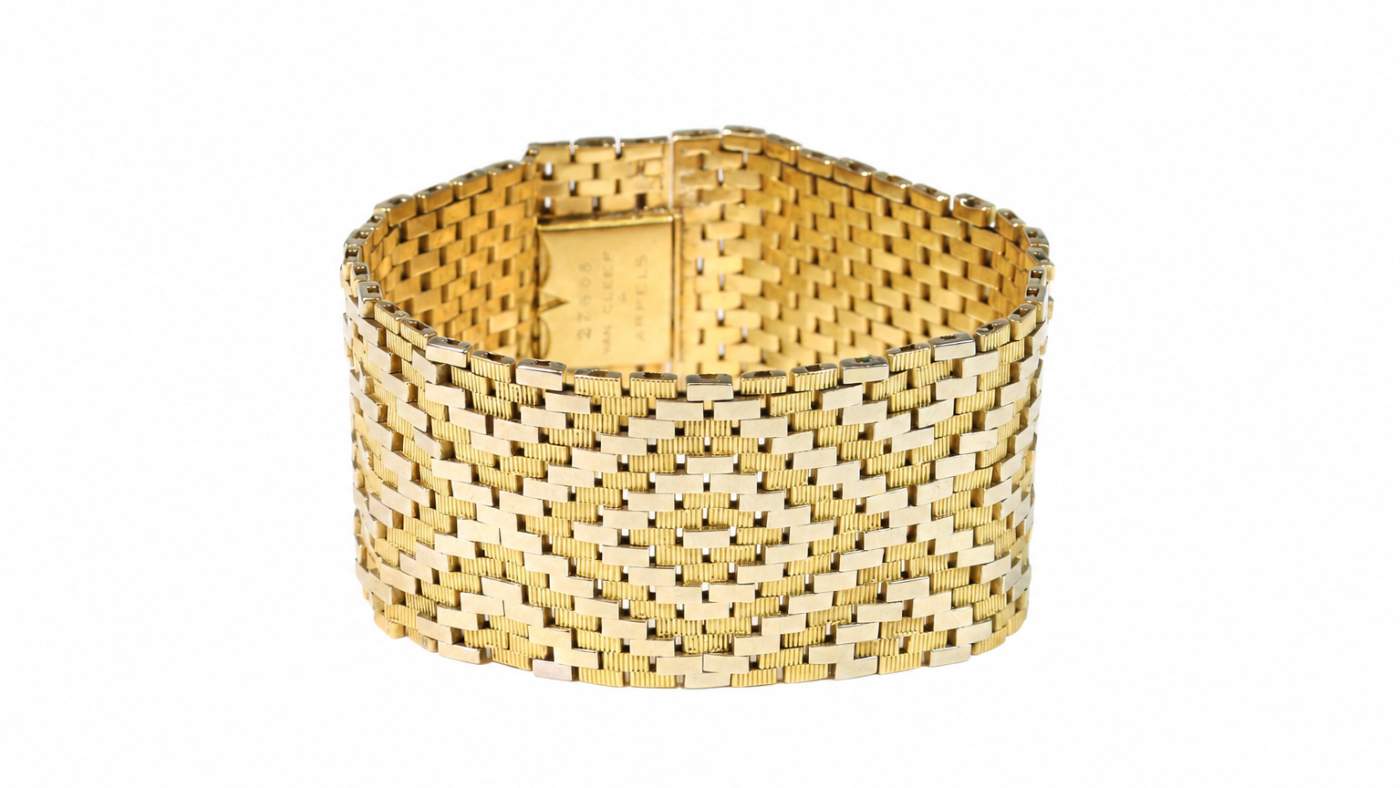
Gold is usually thought of as solid: a precious metal shaped into rings, cast into forms, or set with gemstones. But in the hands of an accomplished jeweler, gold can behave almost like fabric. An 18K yellow and white gold Van Cleef & Arpels mesh bracelet, offered in Alderfer Auction’s December Fine Art Auction, demonstrates just how transformative that idea can be. Hundreds of small interconnected elements create a broad, flexible bracelet with a repeating geometric pattern. Contrasting colors and textures give the surface depth, while the construction allows solid gold to take on the fluid character of a woven textile. It is an intriguing example of another side of Van Cleef & Arpels—one where the artistry comes not from a prominent gemstone or instantly recognizable motif, but from gold itself.
Van Cleef & Arpels: A Parisian Jewelry Tradition
The history of Van Cleef & Arpels stretches back to Paris at the beginning of the twentieth century. The maison was founded in 1906, establishing itself at 22 Place Vendôme, an address that would become synonymous with some of the world's great jewelry houses. Over the decades, Van Cleef & Arpels became known for combining precious materials with imaginative design and sophisticated craftsmanship. Today, many people encountering the name immediately think of the maison's famous Alhambra jewelry. Yet Van Cleef & Arpels' history extends far beyond any single collection. Flowers, animals, ballerinas, elaborate gemstone jewelry, transformable pieces, and innovative goldwork all form part of its design vocabulary. The bracelet offered at Alderfer illustrates why looking beyond the most recognizable motifs can be so rewarding.
When Gold Behaves Like Fabric
Look closely at this bracelet and its construction begins to reveal itself.
From a distance, the surface appears to contain a series of concentric geometric forms. Yellow and white gold travel through the bracelet in repeating lines, creating shapes that seem to expand and contract across its width. Move closer and the illusion changes. The pattern isn't simply engraved or applied to a solid sheet of metal. Instead, numerous individual components have been assembled to create an articulated surface. That construction accomplishes two things simultaneously. First, it produces the bracelet's distinctive geometric decoration. Second, it gives the piece flexibility.This is one of the fascinating contradictions of mesh jewelry. Gold is a dense metal, yet careful construction can make it drape, bend, and conform to the wrist in a manner reminiscent of woven material.
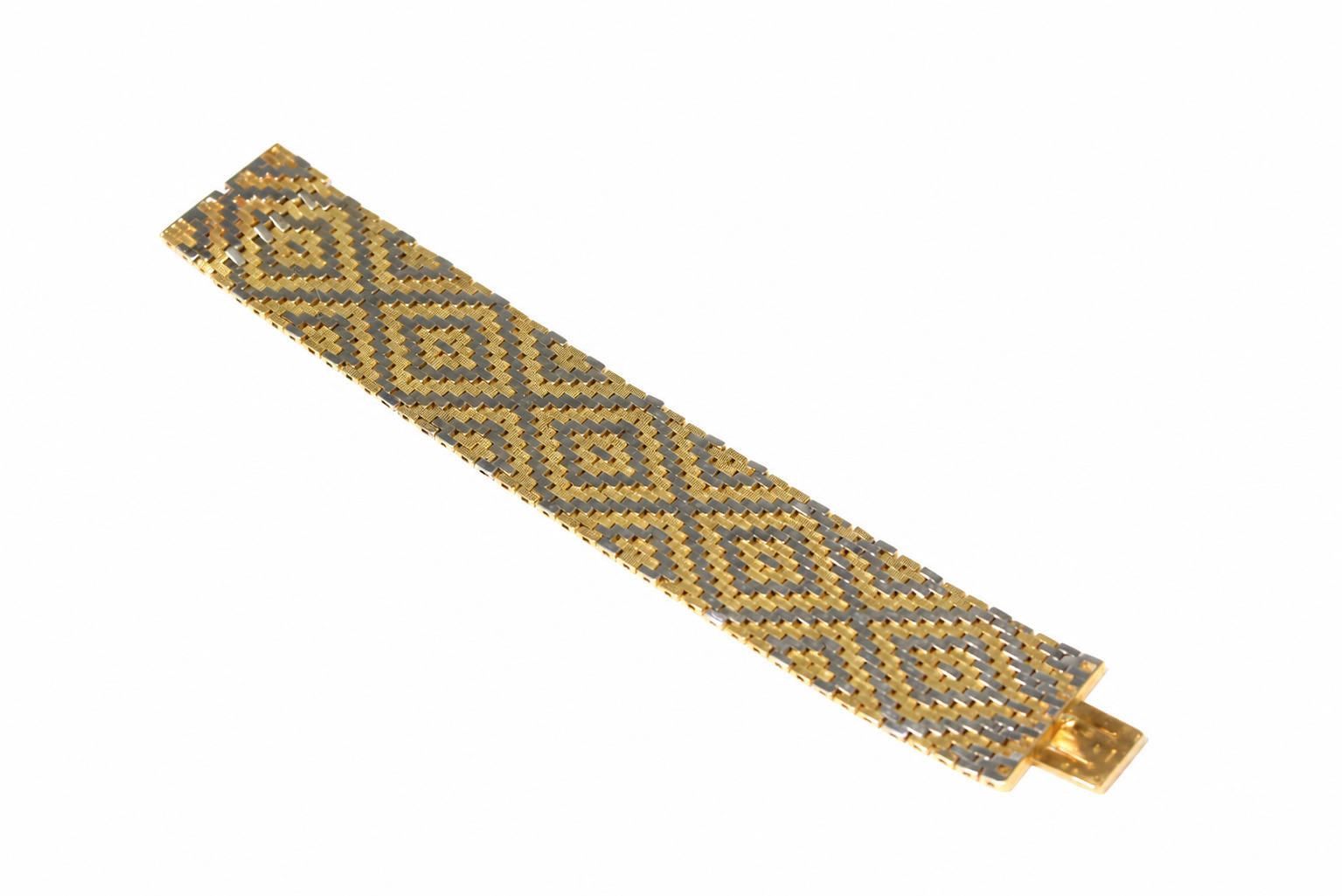
Van Cleef and Arpels two-tone gold bracelet showing geometric mesh pattern.
Yellow Gold Meets White Gold
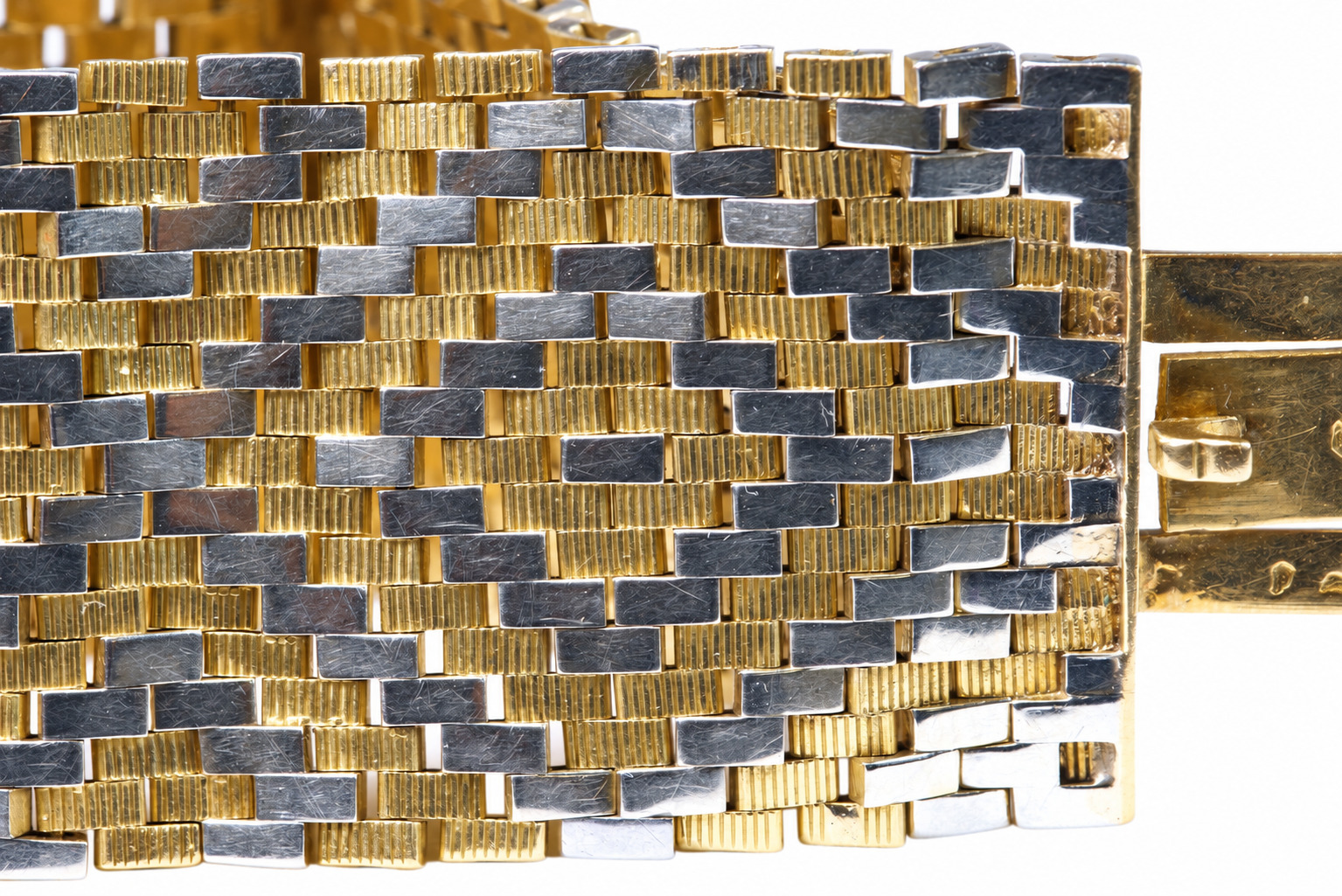
The use of both yellow and white gold is central to the visual effect. The yellow-gold components include textured surfaces that catch light differently from the smoother white-gold elements. Rather than relying on gemstones for contrast, the design uses color, texture, repetition, and reflected light. Viewed closely, individual links resemble tiny architectural blocks.Viewed from farther away, those same blocks disappear into a larger pattern. That ability to work at two scales—the tiny individual component and the complete composition—is part of what makes intricate gold jewelry so compelling. The design also changes with movement. As the bracelet curves around a wrist, individual surfaces catch and release light, making the geometric pattern appear less static than it does when laid flat.
A Signature Matters
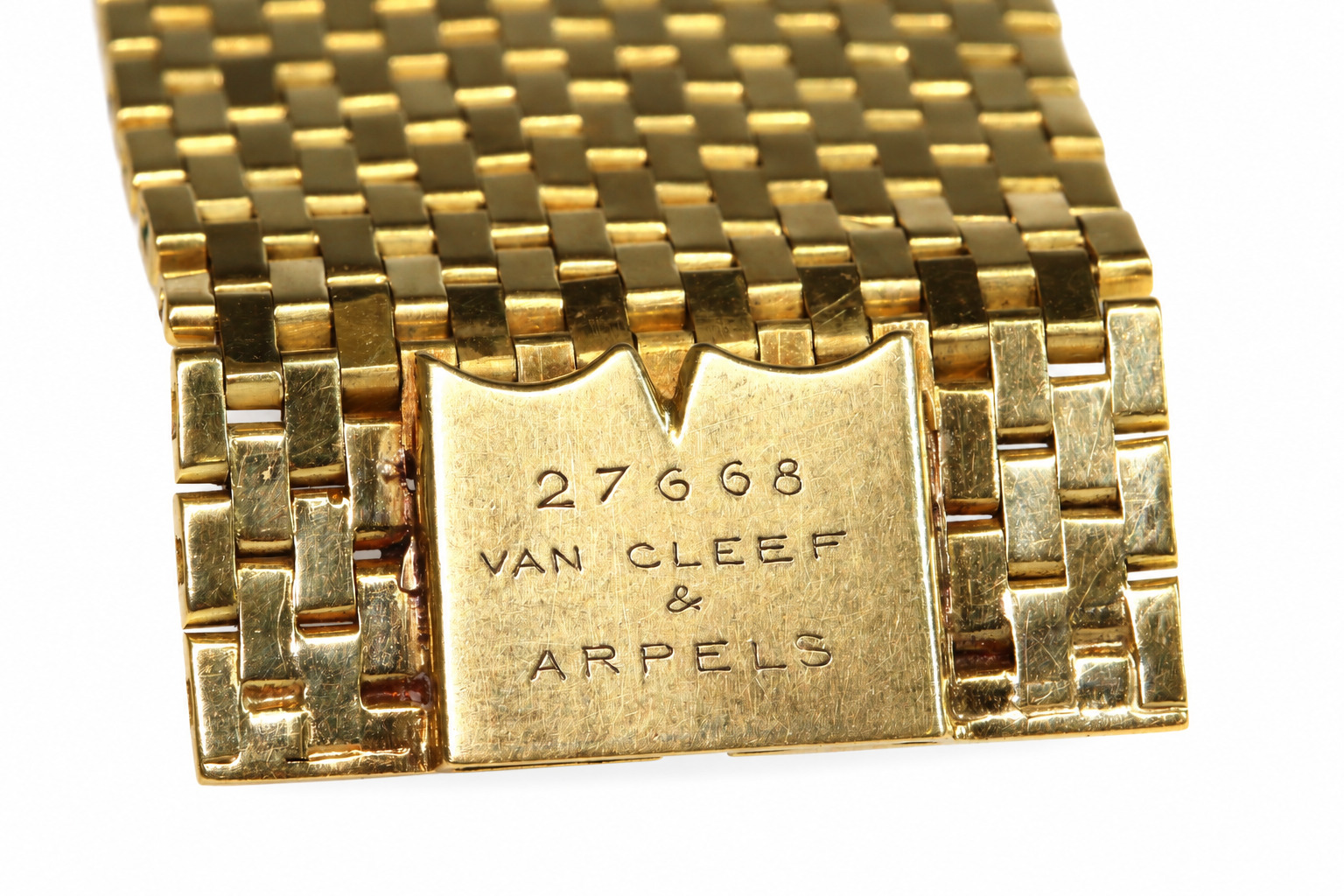
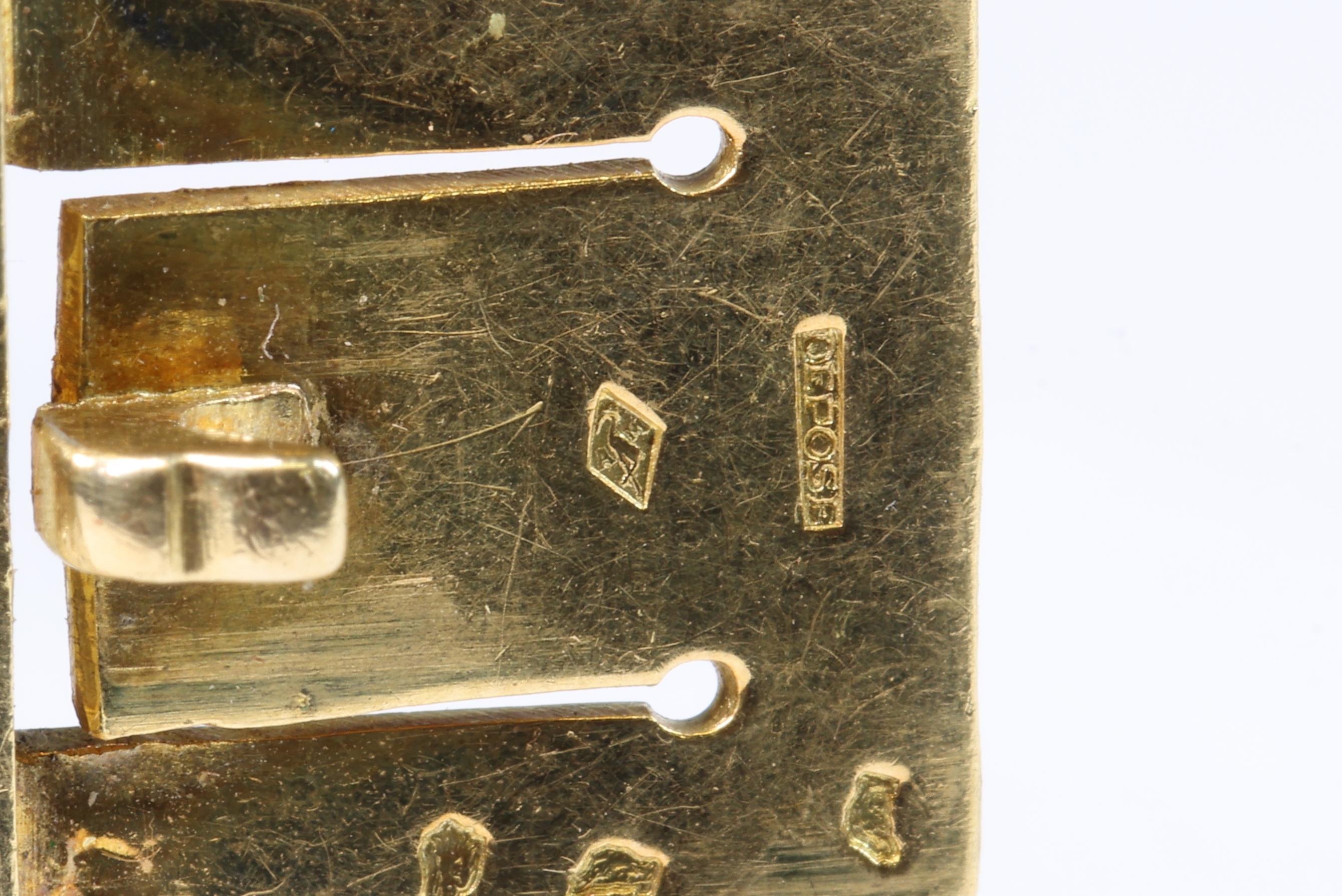
The clasp on the Alderfer bracelet is clearly signed VAN CLEEF & ARPELS and bears the number 27668. For collectors considering signed jewelry at auction, details like these deserve careful examination. Depending on the piece, researchers may look for signatures, numbered marks, precious-metal fineness marks, assay marks, workshop or maker's punches, and other identifying characteristics. These marks can help establish how and where a piece fits within a jewelry house's production. They can also lead to further research.
The Story Told by Hallmarks
The bracelet carries several additional punches, including a small bird-like or crane-like device within a shaped cartouche. Suggested caption: Detail of the bracelet’s additional hallmarks and punches. Further research may help clarify the workshop marks associated with its manufacture. Suggested alt text: Hallmarks and maker marks on Van Cleef and Arpels gold bracelet. This is where jewelry research can become detective work.A prestigious jewelry house does not necessarily mean that every component of every jewel was fabricated by the same individual craftsman under one roof. Historically, major jewelry houses could work with specialized workshops and artisans whose marks may appear alongside those associated with the retailer or maison. For this bracelet, the precise identity represented by the bird-like punch should not be stated without further confirmation. But its presence is worth documenting. In fact, that uncertainty illustrates an important part of cataloging jewelry: good research means knowing when the evidence supports a conclusion—and when an attribution requires more work.
Beyond Gemstones: The Artistry of Construction
Fine jewelry is often discussed in terms of carats. How large is the diamond? What kind of sapphire is it? Where did the emerald originate? This bracelet invites a different conversation. Its primary visual language comes from construction. There is no large central gemstone competing for attention. Instead, the eye follows the repeating yellow- and white-gold pattern from one side of the bracelet to the other. That places the emphasis on design and execution. Every small component contributes to the finished pattern. Alignment matters. Articulation matters. The transition into the clasp matters. Even the reverse of the bracelet becomes interesting because it reveals how the visible design is physically assembled. This is jewelry that rewards looking closely.
What Collectors Should Examine in Signed Van Cleef & Arpels Jewelry
Signed jewelry by a celebrated maison can attract collector attention, but a famous name should never be the end of the examination. When considering a piece of Van Cleef & Arpels jewelry at auction, collectors should look carefully at the signature, numbered marks, hallmarks, materials, construction, condition, dimensions, weight, period, provenance when available, and any accompanying documentation. Condition can be especially important with flexible jewelry. Because an articulated bracelet is designed to move, buyers should consider the condition of its individual links and connections as well as its clasp and safety mechanisms. Evidence of repairs, alterations, replacements, or excessive wear can also merit attention. Prospective bidders should consult the complete auction catalog entry and condition report for information specific to the piece being offered.