
Finn Juhl and the Art of Form: The Vodder Partnership and the Enduring Power of the Judas Table
Finn Juhl and the Art of Form: The Vodder Partnership and the Enduring Power of the Judas Table
Edited by: Christian Answini | Senior Fine Art Specialist
Few figures reshaped the language of modern furniture as profoundly as Danish designer Finn Juhl (1912–1989). Trained as an architect but driven by a sculptor’s eye, Juhl approached furniture not as a subset of architecture but as an independent art form. His chairs and tables possess a sense of anatomical presence—forms that appear to float, stretch, or hover in space. Yet the daring shapes that defined his work could not have existed without the extraordinary technical mastery of cabinetmaker Niels Vodder. Their collaboration stands among the most consequential designer–maker partnerships of the mid-twentieth century, fusing artistic vision with uncompromising craftsmanship at a moment when Danish design was emerging onto the world stage.
Juhl’s path diverged early from traditionalism and strict functionalism, as he sought warmth, sensuality, and individuality. Influences ranged from modern sculpture—Jean Arp and Henry Moore were particular touchstones—to forms seen in nature. This sensibility required a maker capable of executing complex curves, cantilevered components, and finely integrated joints in rare tropical hardwoods. Juhl found that collaborator in Niels Vodder, a Copenhagen cabinetmaker renowned for technical ingenuity and exacting standards.
Their partnership deepened through the annual exhibitions of the Copenhagen Cabinetmakers’ Guild, where Denmark’s leading designers and makers debuted experimental works outside the constraints of mass production. Beginning in the late 1930s, Vodder built many of Juhl’s most ambitious pieces for these exhibitions, translating drawn ideas into objects of startling refinement. In an era before computer modeling or standardized fabrication, each piece demanded hand shaping, iterative prototyping, and meticulous finishing. Vodder’s workshop became the laboratory in which Juhl’s sculptural concepts were brought to life. Together they demonstrated that modern furniture could be simultaneously progressive and artisanal, setting the stage for the international acclaim Danish design would achieve after World War II.
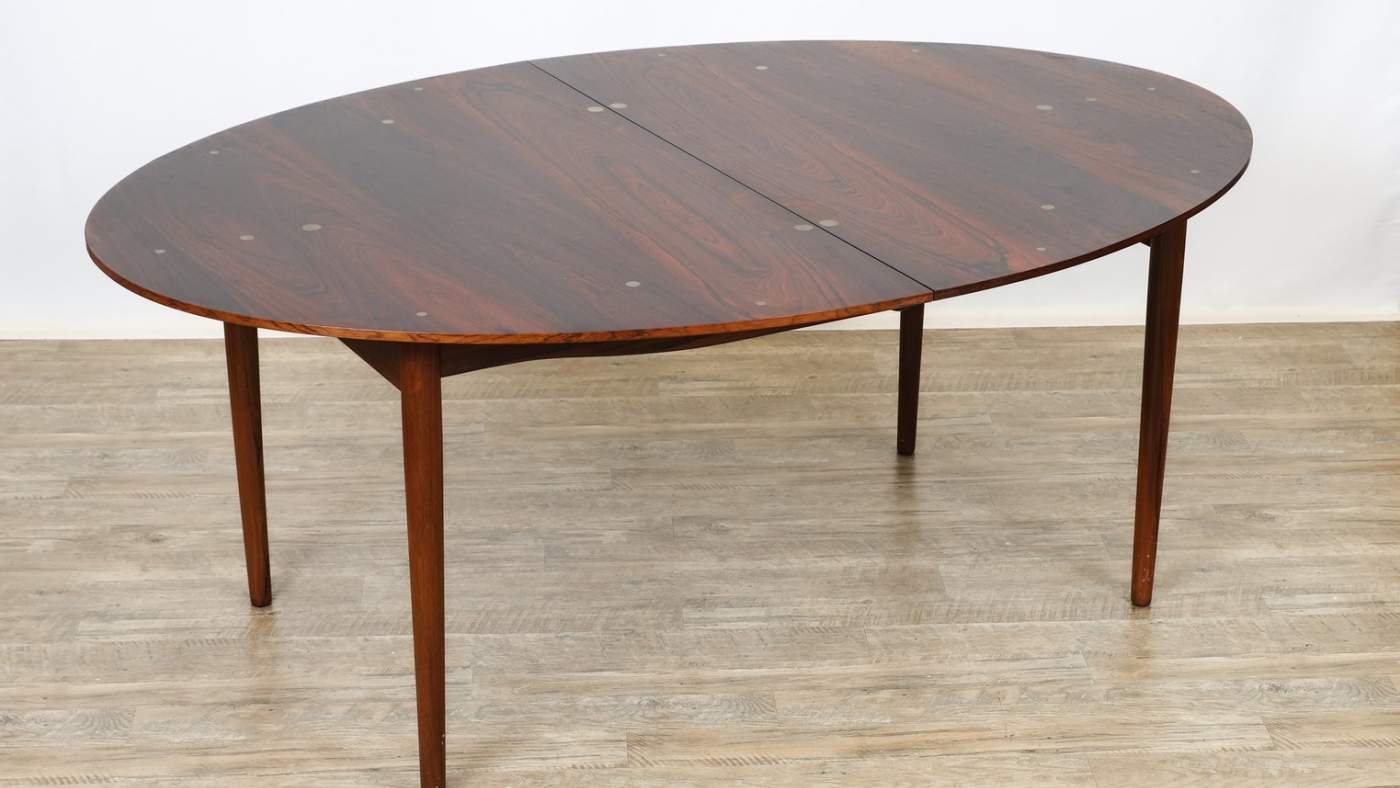
Among the most compelling outcomes of this collaboration is the dining table originally called "The Silver Table", now widely known as the “Judas” table. Designed by Juhl and executed by Vodder, the table is distinguished by a series of small sterling silver discs set into the top. These discs serve as seating guides, and with the original larger version of the table featuring 30 discs, they also gave rise to the nickname “Judas,” an ironic reference to the 30 pieces of silver.
The Judas table exemplifies Juhl’s belief that structure itself could become decoration. The oval top, realized in richly figured rosewood, appears to float above subtly sculpted aprons. Light glances across the surface and catches the inlays, animating the form. In larger versions, the table achieves a near-architectural scale, anchoring a room with quiet authority. Yet Juhl also conceived a smaller variant suited to more compact domestic interiors—an adaptation that preserved the sculptural presence of the design while acknowledging postwar shifts toward apartment living and moderated room sizes.
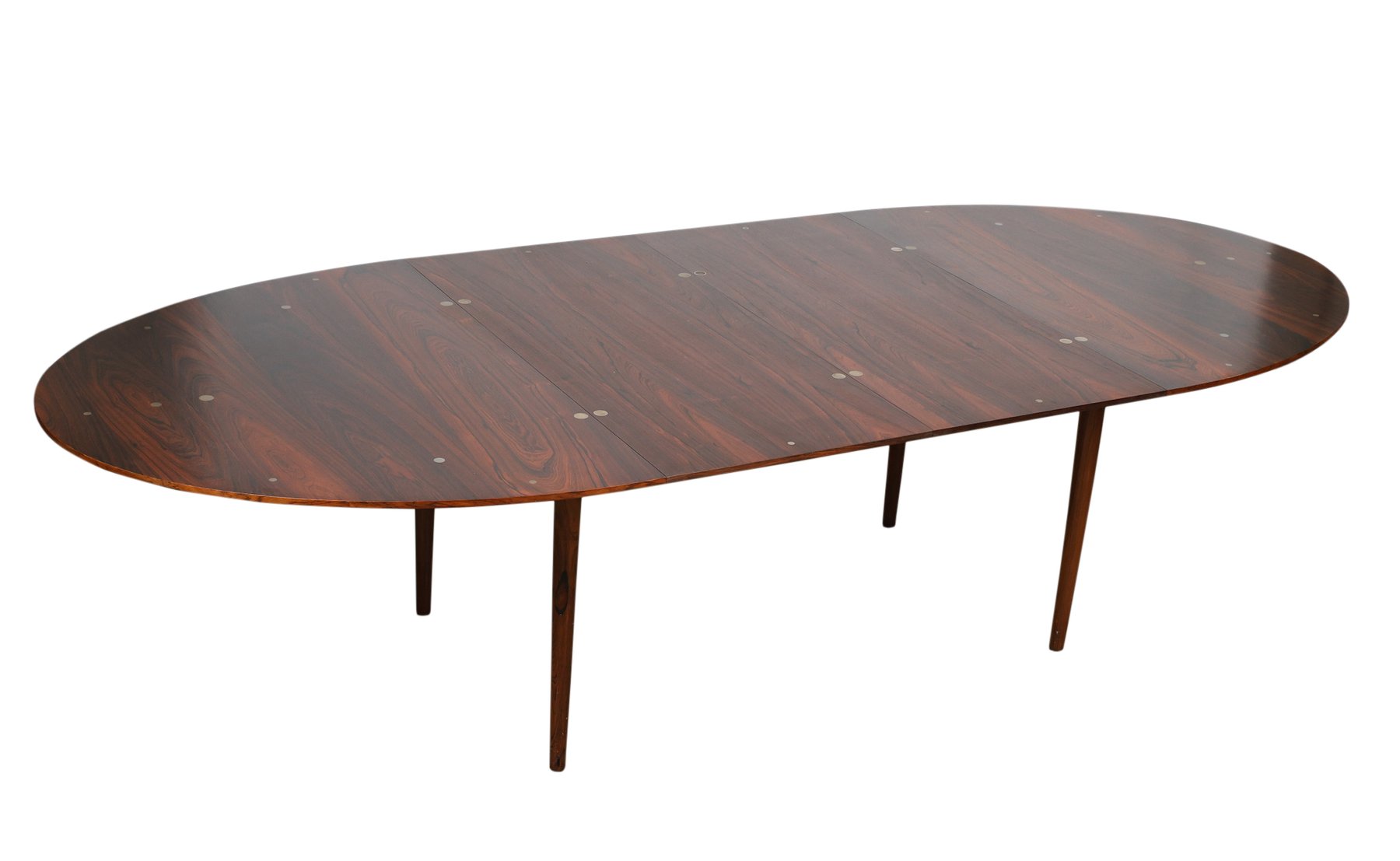
The example offered in Alderfer Auction’s March 18, 2026 Mid-Century Modern sale represents this smaller Judas table format. Its proportions reveal Juhl’s sensitivity to context: monumental character translated into a scale appropriate for everyday use. For collectors and those in search of a utilitarian dining table, this version carries particular appeal. It embodies the full conceptual thrust of the design while fitting comfortably within contemporary homes. As such, it demonstrates Juhl’s ability to balance artistic ambition with lived reality—a quality that distinguishes his finest work.
Collectors and scholars consistently regard the Judas table among Juhl’s most significant dining designs. It encapsulates several defining aspects of his philosophy: structure elevated to ornament, sculptural form achieved through masterful craftsmanship, and an insistence that furniture occupy its own aesthetic. Vodder’s role is inseparable from this achievement. The integration of sterling silver inlays, the precision of joinery, and the luminous finish of the wood attest to a workshop operating at the highest level of cabinetmaking tradition. The Judas table also anchors a broader group of Finn Juhl works in the same Alderfer sale, illuminating different facets of his collaboration with Vodder and his later production with Bovirke. The Model 109 chairs for Niels Vodder, for instance, demonstrate Juhl’s exploration of supportive ergonomics. Their sculpted arms and subtly separated seat and back create a sensation of lightness despite robust construction. In dining settings they often accompany tables of equal sculptural intent, making them natural counterparts to the Judas form.
The Model 53 seating—sofa and easy chairs, also produced by Niels Vodder—occupies another important place within Juhl’s oeuvre. Designed in the mid-twentieth century as Danish design was gaining international traction, the Model 53 series reflects his mature language of suspended volumes and organic contour. Cushions appear to hover within finely profiled wooden frames, the upholstery and structure interacting as independent yet harmonious elements. These pieces reveal Juhl’s architectonic thinking at an intimate scale: the human body cradled within a sculptural structure. Vodder’s craftsmanship again proves essential, allowing a light frame to exist with strength and durability. Complementing these Vodder-made works is the Table Bench, executed by Bovirke. Poul H. Lund, the owner of Bovirke, saw an opportunity to produce Juhl's works on a more industrial and international scale. The bench’s industrial yet softened sculptural appearance makes it as popular today as it was when it debuted.
The enduring desirability of Finn Juhl furniture lies in the synthesis of artistry and function. Each piece carries the imprint of handicraft at its highest expression, combined with a design sensibility that remains unmistakably modern. And as collecting interest in Danish Modernism has matured, works bearing the dual authorship of Juhl and Vodder have come to represent a pinnacle within the field. They offer not only aesthetic distinction but also historical significance, embodying the moment when Denmark’s craft tradition reshaped international perceptions of modern design. Today, the Judas table and its companion pieces resonate as strongly as when first exhibited in Copenhagen decades ago.All of these pieces were originally purchased in the 1960's from Reese Palley Interiors. From 1957-1979, Palley owned and operated galleries in Atlantic City and other locations, specializing in Danish Modern furniture, Boehm porcelains, and fine art, and for a number of years ran a Danish design studio. He branded himself as "Merchant to the Rich," catering to wealthy clientele across his multiple locations. He and his wife Marilyn devoted years to rigorously cataloguing the entire canon of 20th-century Danish design, culminating in the Palley Index. The furniture index has since been developed further by Design museum Danmark. It stands as one of the most comprehensive reference works on Danish modern design ever assembled.
These Finn Juhl works with provenance from Reese Palley Interiors will be offered in Alderfer Auction’s Mid-Century Modern sale on March 18, 2026. The auction will be conducted online with absentee and phone bidding available. Public preview will be held March 16–17, 9:00 AM–3:00 PM.
Sources:
House of Finn Juhl (finnjuhl.com) House of Finn Juhl. Explore the Collection. OneCollection. https://finnjuhl.com/
Shore Local Newsmagazine (shorelocalnews.com) Klauber, Bruce. "Recalling Reese Palley: The Boardwalk's Eccentric Merchant to the Rich." Shore Local Newsmagazine, April 25, 2024. https://shorelocalnews.com/recalling-reese-palley-the-boardwalks-eccentric-merchant-to-the-rich/
Designmuseum Danmark: Furniture Index (mus.reindex.net) Designmuseum Danmark. Furniture Index. Founded by Marilyn Arnold Palley and Reese Palley. Bredgade 68, 1260 København K. https://mus.reindex.net/DMFURT/main/Landing.php