
Three Signatures That Shaped the Modern World
Three Signatures That Shaped the Modern World
Tesla, the Supreme Court, and America’s Wartime Leaders in Alderfer Auction’s March 19 Fine & Decorative Arts Sale
Written by: Christian Answini | Fine Art Department
Autographs are more than ink on paper. A signature can represent a turning point in history, a moment when an individual’s ideas, authority, or leadership helped shape the modern world. In Alderfer Auction’s March 19, 2026 Fine & Decorative Arts sale, several autograph highlights embody exactly that idea. A rare signed cabinet card of Nikola Tesla, a significant group of Supreme Court signatures, and an archive connected to John McCain that includes signatures of Theodore Roosevelt, John J. Pershing, and Douglas MacArthur collectively represent three powerful forces that defined the last century: scientific innovation, constitutional law, and American military leadership.
Viewed together, these signatures form a compelling narrative about how individuals—and the decisions they made—helped build the world we live in today.
Tesla and the Future of Electricity
Few figures symbolize technological transformation as vividly as Nikola Tesla. Born in 1856 in what is now Croatia, Tesla became one of the most influential inventors of the modern age, pioneering developments in electrical engineering that laid the groundwork for the power systems that run cities, industries, and homes across the globe. Tesla’s work on alternating current fundamentally reshaped the electrical landscape of the late nineteenth century. At a time when direct current systems dominated early electrical infrastructure, Tesla’s alternating current technology proved capable of transmitting power across far greater distances. This innovation allowed electricity to move beyond small urban networks and into regional and national grids, making large-scale electrification possible. Because Tesla was more focused on invention than on self-promotion or documentation, authentic autographs from him are not as common as those of many public figures from the same period. Signed photographs are especially desirable. The cabinet card format, popular in the late nineteenth century, was often used for formal portraits and offered a dignified way for notable individuals to present their likeness. A signed Tesla cabinet card therefore occupies a unique place in the autograph world. It represents not only the signature of a brilliant inventor but also a visual artifact of the era in which electricity itself was transforming society. For collectors of scientific history, technology, or rare autographs, such pieces embody the moment when modern electrical life began.
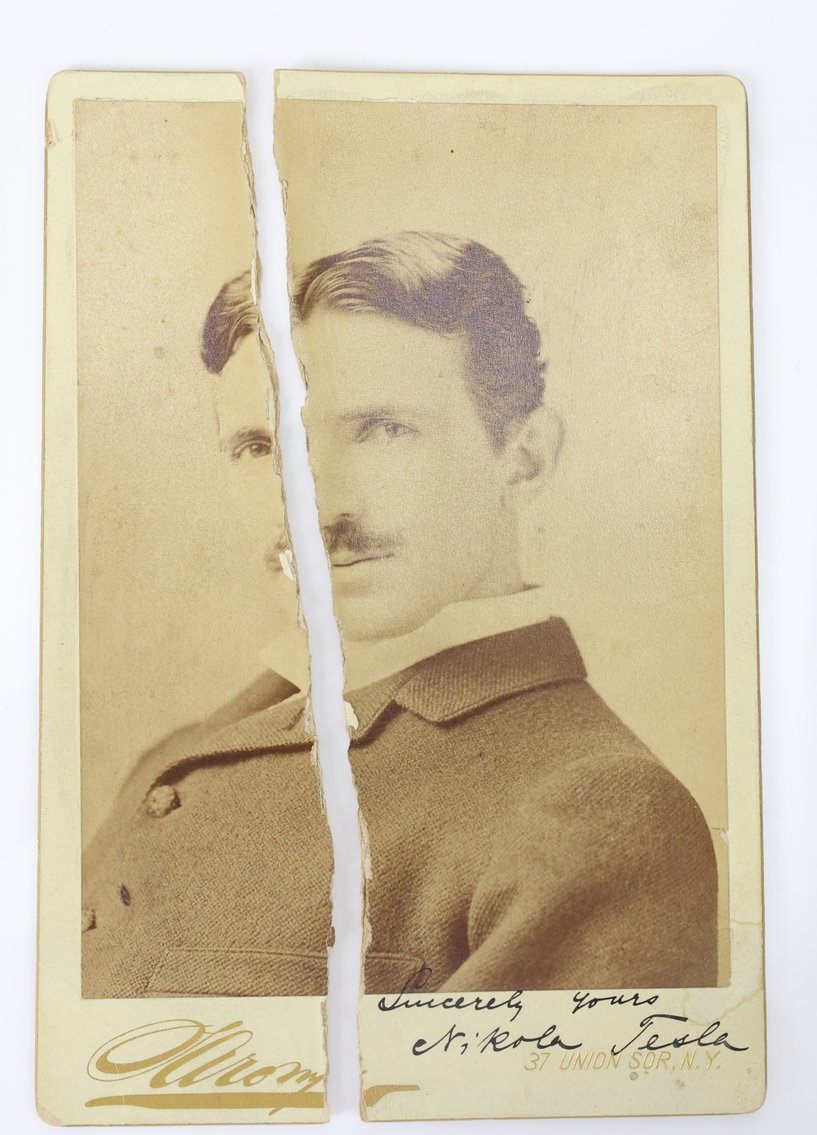
#4190 • Autograph of Inventor Nikola Tesla
The Supreme Court and the Rule of Law
While Tesla’s legacy lies in invention, the authority of the United States Supreme Court rests in interpretation—specifically, the interpretation of the Constitution that defines the framework of American law. Since the nation’s founding, the Supreme Court has served as the ultimate arbiter of constitutional meaning. Its decisions influence nearly every dimension of American life, from civil liberties to federal authority. Because of this role, the signatures of Supreme Court justices hold a particular fascination for collectors of American history. Unlike presidents or military leaders, Supreme Court justices often remain outside the spotlight of popular culture. Yet their influence can be equally profound. Landmark decisions issued by the Court have shaped the nation’s political structure, civil rights, and legal standards for more than two centuries.
A group of Supreme Court autographs captures the collective authority of the institution rather than the reputation of a single individual. It reflects the Court as a body—nine justices deliberating over questions that define the meaning of American law.
In the context of the approaching 250th anniversary of the United States in 2026, such historical signatures take on added resonance. They remind us that the Constitution, drafted in the eighteenth century, remains the foundation of American governance today. The justices who interpret it are part of an ongoing tradition that connects the founding era to the present day. For collectors, Supreme Court autographs therefore represent more than judicial memorabilia. They symbolize the enduring structure of American democracy.
Roosevelt, Pershing, and MacArthur: Leadership in War
If Tesla represents innovation and the Supreme Court represents law, the signatures of Theodore Roosevelt, John J. Pershing, and Douglas MacArthur represent another defining force of modern history: military leadership.
Each of these figures played a major role in shaping America’s position on the global stage during the twentieth century. Theodore Roosevelt, the twenty-sixth president of the United States, embodied the nation’s transition into a modern world power. His leadership combined political reform at home with a more assertive international presence abroad. Roosevelt’s influence extended beyond his presidency, helping define American diplomacy and military policy in the early twentieth century.
General John J. Pershing emerged as the central American military leader of the First World War. As commander of the American Expeditionary Forces in Europe, Pershing oversaw the deployment of more than two million American soldiers. His leadership helped transform the United States from a regional power into a decisive participant in global conflict.
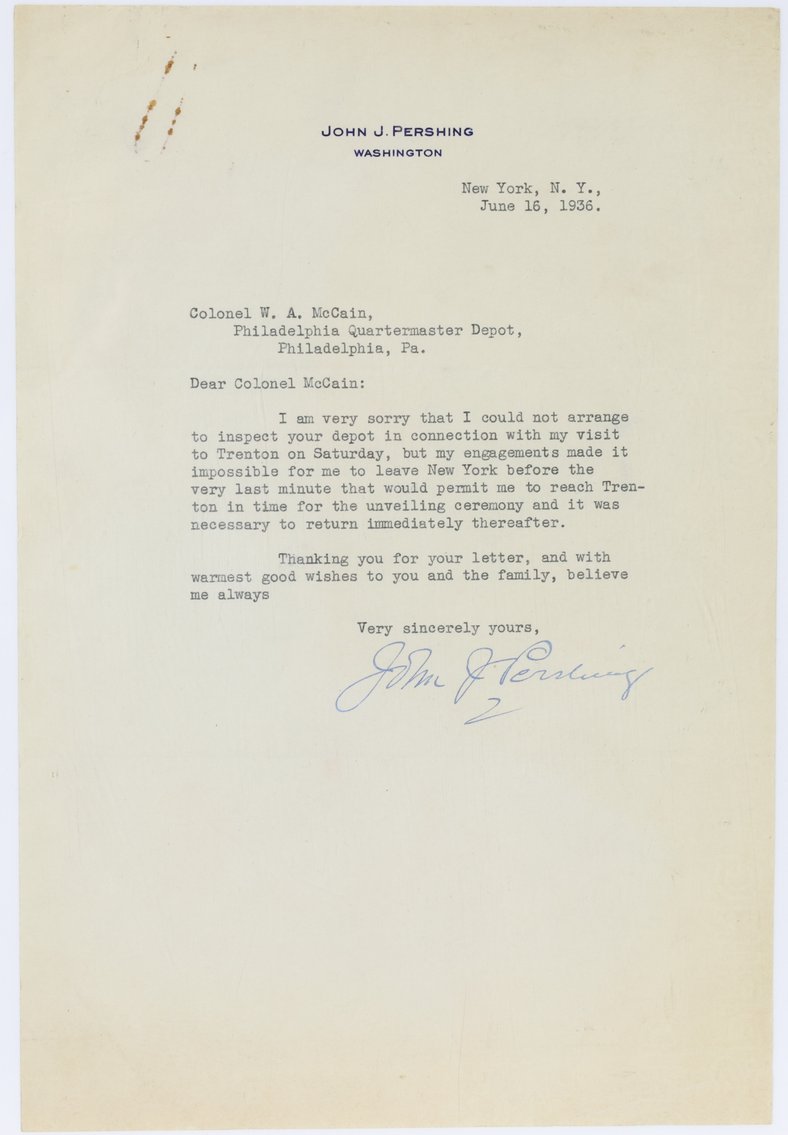
#4199 • Military Archive-Teddy Roosevelt, MacArthur and Pershing Autographs
Douglas MacArthur’s career bridged both world wars and continued through the Cold War era. Known for his strategic vision and commanding presence, MacArthur became one of the most recognizable American military leaders of the twentieth century.
Together, these figures represent a century in which the United States increasingly assumed a central role in world affairs. Their signatures, preserved within the McCain archive included in the March 19 auction, capture the human dimension of that transformation.
Autographs connected to military leadership often carry a particular emotional resonance. They recall moments when the stakes of history were measured not just in politics or law but in the lives of soldiers and the outcomes of global conflict.
Signatures as Historical Witnesses
Taken individually, each autograph in the March 19 auction represents a remarkable historical figure. Viewed together, they tell a broader story about the forces that shaped the modern world. Tesla’s signature represents the technological revolution that electrified cities and industries.The Supreme Court signatures represent the legal framework that governs American society. The Roosevelt, Pershing, and MacArthur signatures represent the leadership that guided the United States through some of the most consequential conflicts of the twentieth century. In this way, autographs serve as quiet historical witnesses. A simple signature—ink applied in a moment—can survive long after the events and decisions that made that individual famous.
Autographs in Alderfer’s March 19 Auction
These autograph highlights will appear as part of Alderfer Auction’s March 19, 2026 Fine & Decorative Arts auction, an online sale with phone bidding available. Public preview will be held March 16, 17, and 18 from 9:00 AM to 3:00 PM, with private viewings available by appointment. While the auction features an exceptional selection of fine art and decorative objects, the autograph material offers collectors an opportunity to connect directly with the individuals whose ideas, authority, and leadership helped shape the modern era.As the United States approaches its 250th anniversary, objects tied to the nation’s intellectual, legal, and military history take on renewed significance. Signatures such as these remind us that history is not only written in books but also preserved in the personal marks left behind by those who shaped it.
And sometimes, those marks fit within a single line of ink.