
The Enduring Appeal of Picasso’s Linocuts: Innovation, Color, and Le Vieux Bouffon
The Enduring Appeal of Picasso's Linocuts: Innovation, Color, and Le Vieux Bouffon
Written by: Christian Answini | Senior Fine Art Specialist
Few artists have transformed as many artistic mediums as Pablo Picasso. While he is most closely associated with Cubism and modern painting, his achievements as a printmaker are equally remarkable. Throughout his career, Picasso explored etching, lithography, aquatint, drypoint, and linoleum cut printing, continually pushing the boundaries of what each medium could accomplish. Among these, his colorful linocuts of the late 1950s and early 1960s stand as some of his most inventive and visually striking works.
Today, Picasso's original linocuts occupy a unique place in the art market. They are celebrated not simply as reproductions of famous paintings, but as original works conceived specifically for the printmaking process. Their bold colors, simplified forms, and expressive energy have made them enduring favorites among collectors and museums alike. One such work, Le Vieux Bouffon ("The Old Jester"), exemplifies this extraordinary period of experimentation. It will be offered in Alderfer Auction's September Fine Arts & Mid-Century Modern Auction, providing collectors with an opportunity to acquire an original print that reflects one of the master's most innovative chapters.
Reinventing an Ancient Printmaking Technique
Linoleum printing, or linocut, emerged in the early twentieth century as an accessible alternative to the traditional woodcut. Instead of carving into wood, artists cut away areas of soft linoleum, rolled ink across the remaining raised surface, and transferred the image onto paper under pressure. The medium offered crisp, graphic lines and broad fields of color, making it attractive to artists interested in bold visual statements. Although many artists embraced linocut for its simplicity, Picasso saw something more. During the late 1950s, while living in Vallauris in the South of France, he began collaborating with master printer Hidalgo Arnéra. Together, they explored ways to expand the expressive possibilities of the medium, transforming what had often been considered a straightforward printmaking technique into a vehicle for extraordinary artistic complexity.
Rather than treating linoleum as merely another printing surface, Picasso approached it with the same restless curiosity that defined every stage of his career.

Picasso's Revolutionary Reduction Technique
One of Picasso's greatest contributions to printmaking was his refinement of the reduction linocut, sometimes called the "suicide block" method. Traditionally, each color required its own carved printing block. Picasso instead developed a process in which multiple colors could be printed from a single block. After printing the first color, additional sections of the block were carved away before applying the next color. This sequence continued until the image was complete. The process demanded extraordinary planning. Once a section was removed, it could never be restored, meaning every decision permanently altered the printing block. The result was a remarkable fusion of technical precision and artistic spontaneity. This innovation allowed Picasso to create vibrant compositions with fewer blocks while preserving the bold graphic quality that has become synonymous with his linocuts. Today, these reduction prints remain among the most admired examples of twentieth-century printmaking.
The Bold Language of Picasso's Late Style
By the early 1960s, Picasso was in his eighties, yet his creative energy showed little sign of slowing. Rather than repeating earlier successes, he continued experimenting with new materials, techniques, and subjects. His late prints display an unmistakable confidence. Faces become simplified into expressive lines and vibrant shapes. Color is used emotionally rather than realistically. Figures often appear playful, theatrical, or deliberately exaggerated, recalling masks, performers, and characters drawn from centuries of European artistic tradition. These works demonstrate that Picasso viewed printmaking not as a secondary practice but as an independent artistic language. The strong contours and flattened color fields that characterize his linocuts allowed him to communicate emotion with remarkable economy, proving that complexity often emerges through simplification rather than detail.
Le Vieux Bouffon: A Playful Masterpiece of Picasso's Printmaking
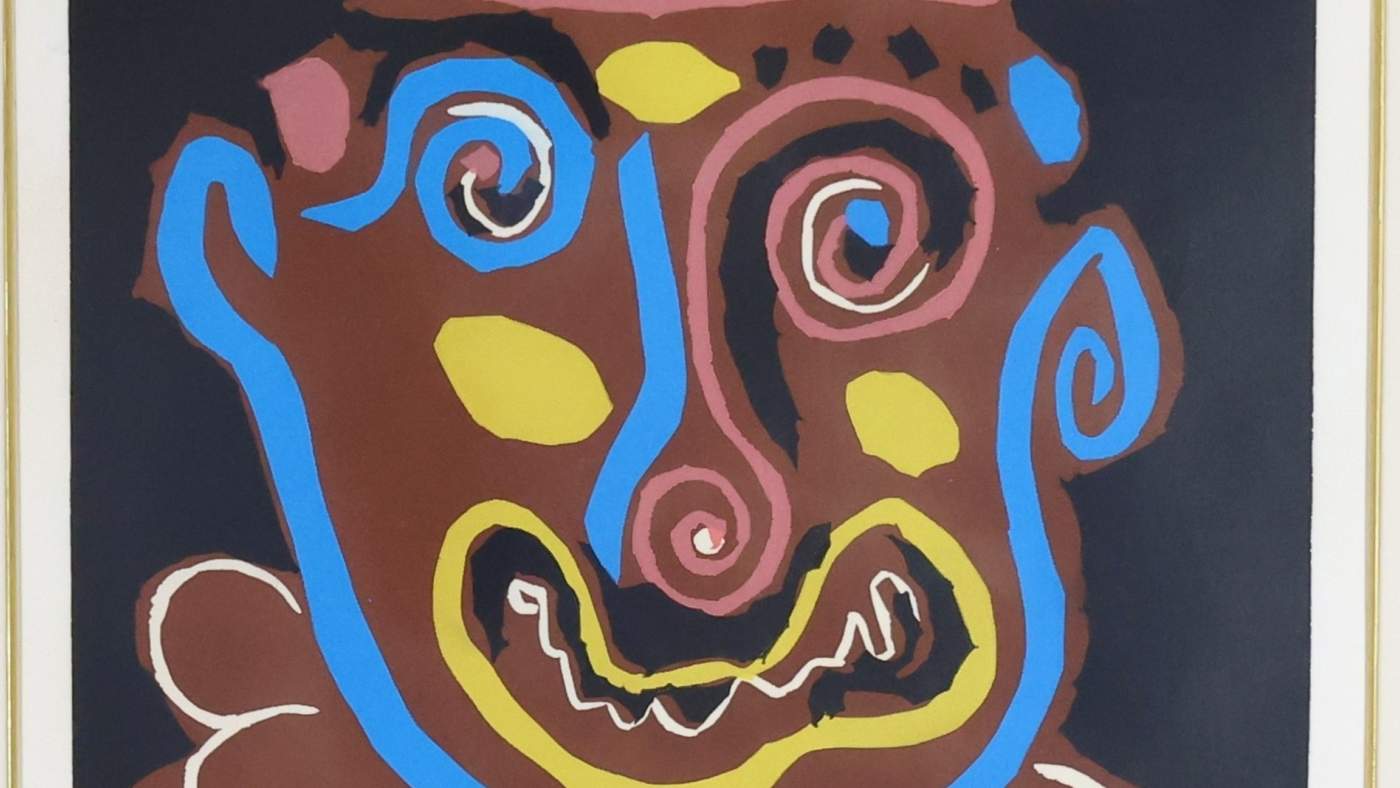
Executed in 1963, Le Vieux Bouffon belongs to this celebrated late period and beautifully illustrates Picasso's command of the linocut medium. The title translates as "The Old Jester," a subject deeply rooted in European art history. Court jesters and entertainers have long fascinated artists, serving as symbols of wit, performance, humanity, and the blurred line between comedy and tragedy. Picasso revisited these theatrical figures throughout his career, finding in them endless opportunities for psychological expression. In Le Vieux Bouffon, the figure's crowned cap, exaggerated features, and swirling facial lines create an image that feels both whimsical and enigmatic. Brilliant blues, yellows, pinks, and earthy browns animate the composition, while thick black outlines unify the design into a powerful graphic statement. Rather than striving for realism, Picasso invites viewers to respond emotionally to color, rhythm, and expression. The image possesses an immediacy that feels remarkably contemporary, even more than sixty years after its creation.
The example featured in Alderfer's September Fine Arts & Mid-Century Modern Auction is a linoleum cut printed in colors on Arches wove paper, signed in pencil lower right. Executed in 1963, this impression is number 39 from the edition of 160, plus approximately 30 artist's proofs, and was published by Edition La Patriote. These details place the work firmly within Picasso's documented printmaking oeuvre and reflect the careful collaboration between artist, printer, and publisher that defines original fine art prints.
.jpg)
Why Picasso Linocuts Continue to Captivate Collectors
Original Picasso prints occupy a distinctive position within the art market because they offer direct access to the artist's creative process. Unlike reproductions, each authorized edition was conceived, carved, and printed as an original work of art, making the print itself the intended final expression. Collectors continue to value Picasso's linocuts for several reasons. Their historical significance reflects a period when one of the twentieth century's greatest artists fundamentally reimagined an established printmaking technique. Their bold visual language remains instantly recognizable, appealing to both seasoned collectors and newcomers to modern art. Limited edition sizes, documented provenance, and respected publishers further contribute to their enduring desirability. Equally important is their place within Picasso's broader artistic legacy. While his paintings often command headlines, his prints have long been recognized by museums and scholars as essential works that reveal the same inventive spirit through an entirely different medium.
A Lasting Legacy in Print
Picasso approached every medium with remarkable curiosity, but his linocuts stand apart for the way they combine technical innovation with joyful artistic freedom. Through bold color, simplified form, and revolutionary printmaking methods, he elevated the humble linoleum block into one of the defining artistic tools of the twentieth century. Le Vieux Bouffon embodies that achievement. Its expressive character, vibrant composition, and technical sophistication illustrate why Picasso's original linocuts remain among the most celebrated works in modern printmaking.
Collectors and admirers of twentieth-century art are invited to explore this exceptional impression, along with other noteworthy works, in Alderfer Auction's September Fine Arts & Mid-Century Modern Auction. As both an original work of art and a testament to Picasso's enduring spirit of innovation, Le Vieux Bouffon offers a compelling glimpse into one of the most creative periods of the artist's remarkable career.