
Benton Spruance and the American Scene: 5 Powerful Lithographs of Modern Life
Benton Spruance and the American Scene: 5 Powerful Lithographs of Modern Life
Edited by Christian Answini | Senior Fine Art Specialist
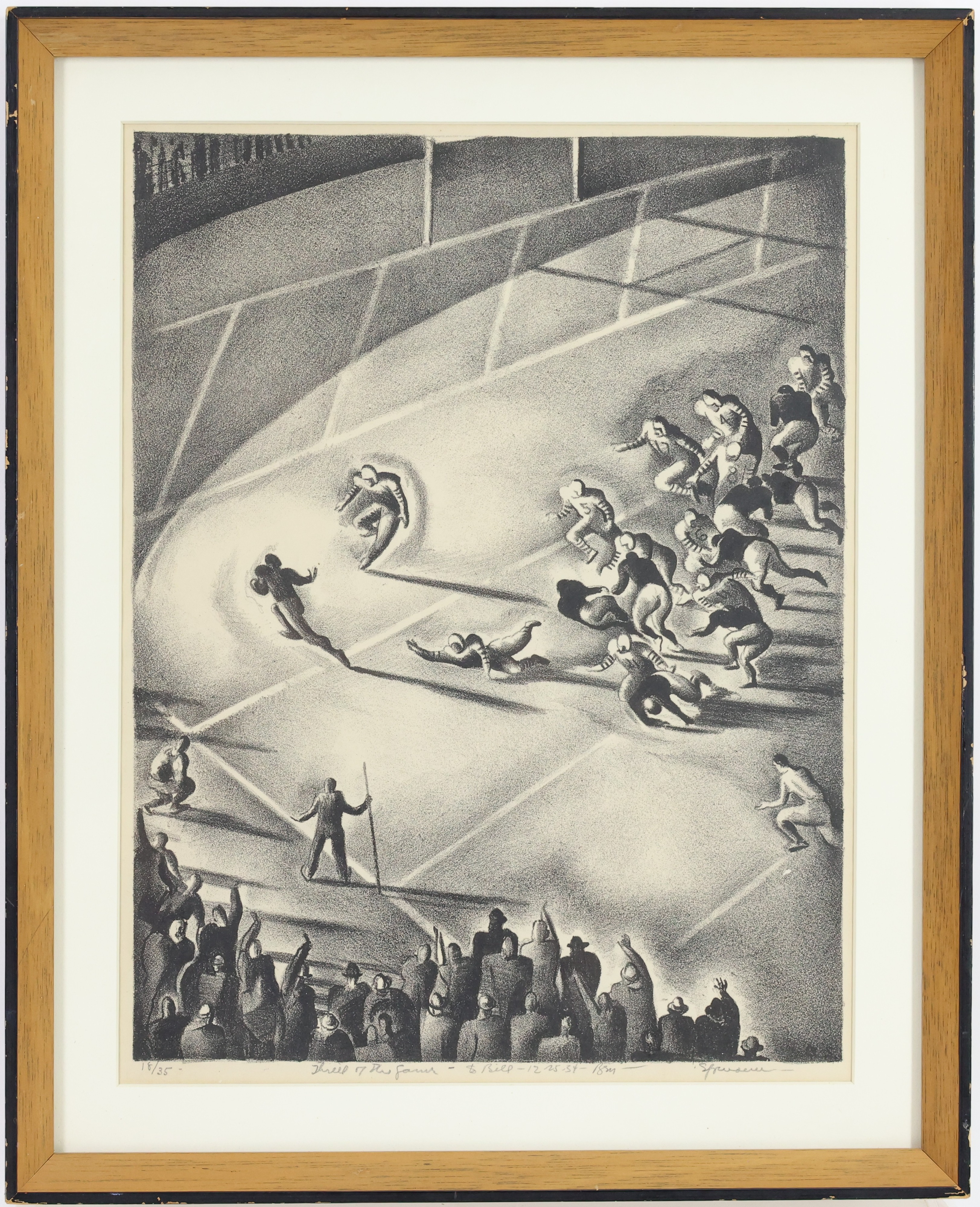
Benton Spruance found compelling subjects in the world around him. Football players racing across a field, commuters pushing through a station, crowds gathering in the city, and even the quiet architecture of a Pennsylvania street could become the starting point for an extraordinary lithograph. Born in Philadelphia in 1904, Spruance became an important figure in twentieth-century American printmaking. His work combines recognizable scenes of American life with a growing interest in movement, geometry, rhythm, and abstraction. Five lithographs by Spruance featured in Alderfer’s September 10 Fine Art Auction provide an opportunity to explore that range. Two are particularly revealing: Thrill of the Game and Shovel Pass, both devoted to football but approaching the sport from very different perspectives.
Benton Spruance, Thrill of the Game, lithograph. Offered in Alderfer’s September 10 Fine Art Auction.
Benton Spruance and Modern American Life
Spruance studied at the Pennsylvania Academy of the Fine Arts, placing him within Philadelphia's long artistic tradition. Although he worked in several media, lithography became especially important to his career. It was an ideal medium for an artist fascinated by motion. Lithography allowed Spruance to work with rich blacks, soft grays, sharp highlights, and subtle tonal transitions. He could create figures that seem to emerge from darkness or disappear into a crowd. Light could become almost as important as the people depicted. During the 1930s and 1940s, Spruance frequently turned toward subjects drawn from contemporary American experience. Rather than looking exclusively to traditional landscapes or historical scenes, he found modern life itself worthy of serious art. Football was one of those subjects. In Thrill of the Game, Spruance takes a broad view of the football field. Players move across a brightly illuminated playing surface while spectators gather around its edges. Long shadows stretch dramatically behind the athletes. The stadium lighting turns the field into a stage, while the surrounding darkness intensifies the action. The composition isn't simply about which team has possession of the ball. Spruance captures the experience of watching football—the speed, anticipation, spectators, artificial light, and sudden changes of direction. It is football transformed into visual theater.
Shovel Pass: Inside the Action
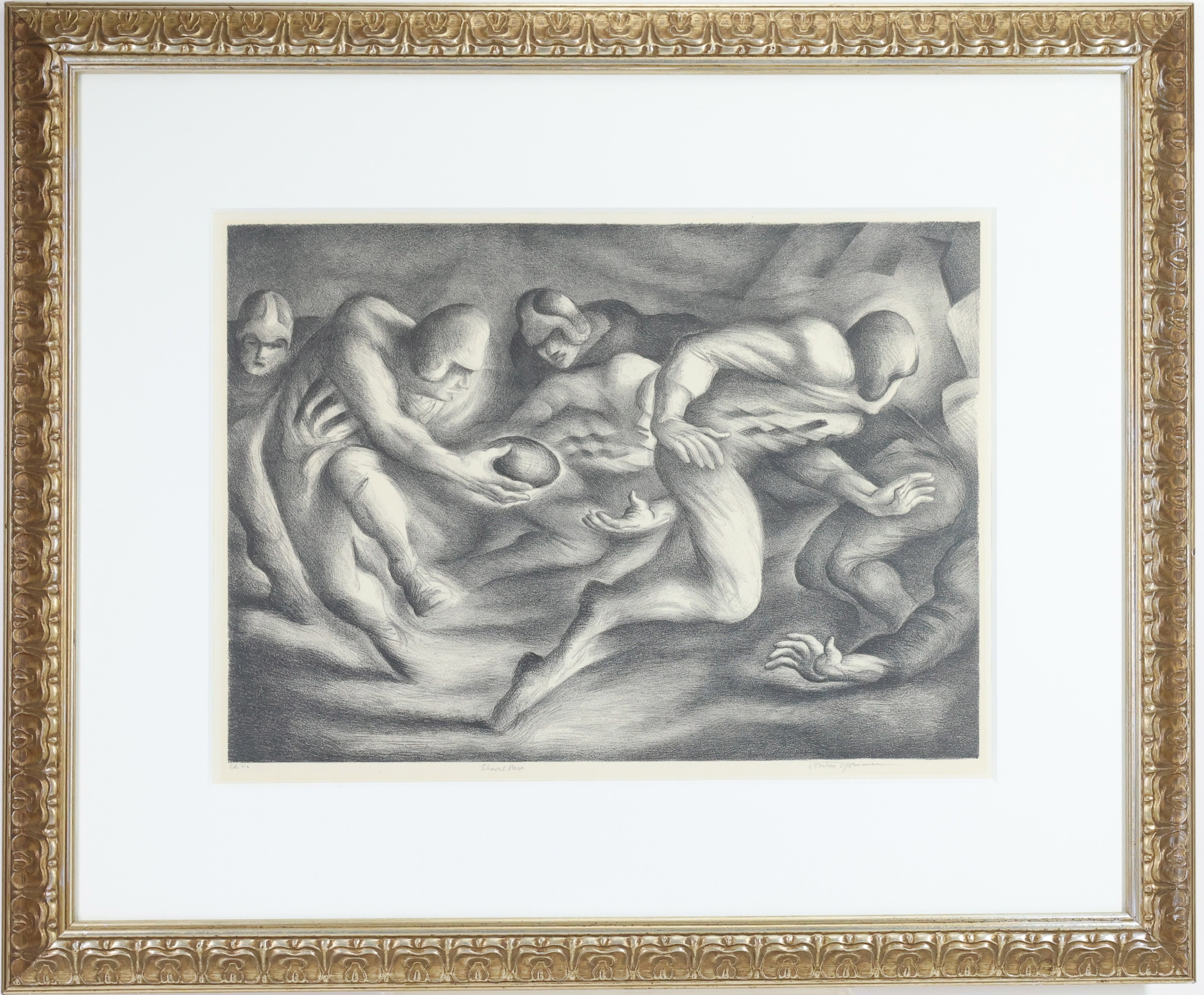
The second football lithograph approaches the sport very differently. In Shovel Pass, Spruance moves much closer to the players. Instead of presenting the entire field, he compresses the action into an intense arrangement of overlapping bodies. Players lean, reach, collide, and twist around the football. Arms and legs create sweeping curves while the figures seem to merge into a single moving form. This is where Spruance's interest in modernism becomes especially apparent. From a distance, the composition can almost appear abstract. Yet it represents a recognizable moment from football. Spruance takes the physical action of a shovel pass and reduces it to force, rhythm, direction, mass, and movement. Placed together, Thrill of the Game and Shovel Pass offer two fascinating views of the same sport. One shows us football as a public spectacle; the other puts us directly inside the physical action.
Benton Spruance Shovel Pass football lithograph showing players in motion.
The Energy of the Modern City
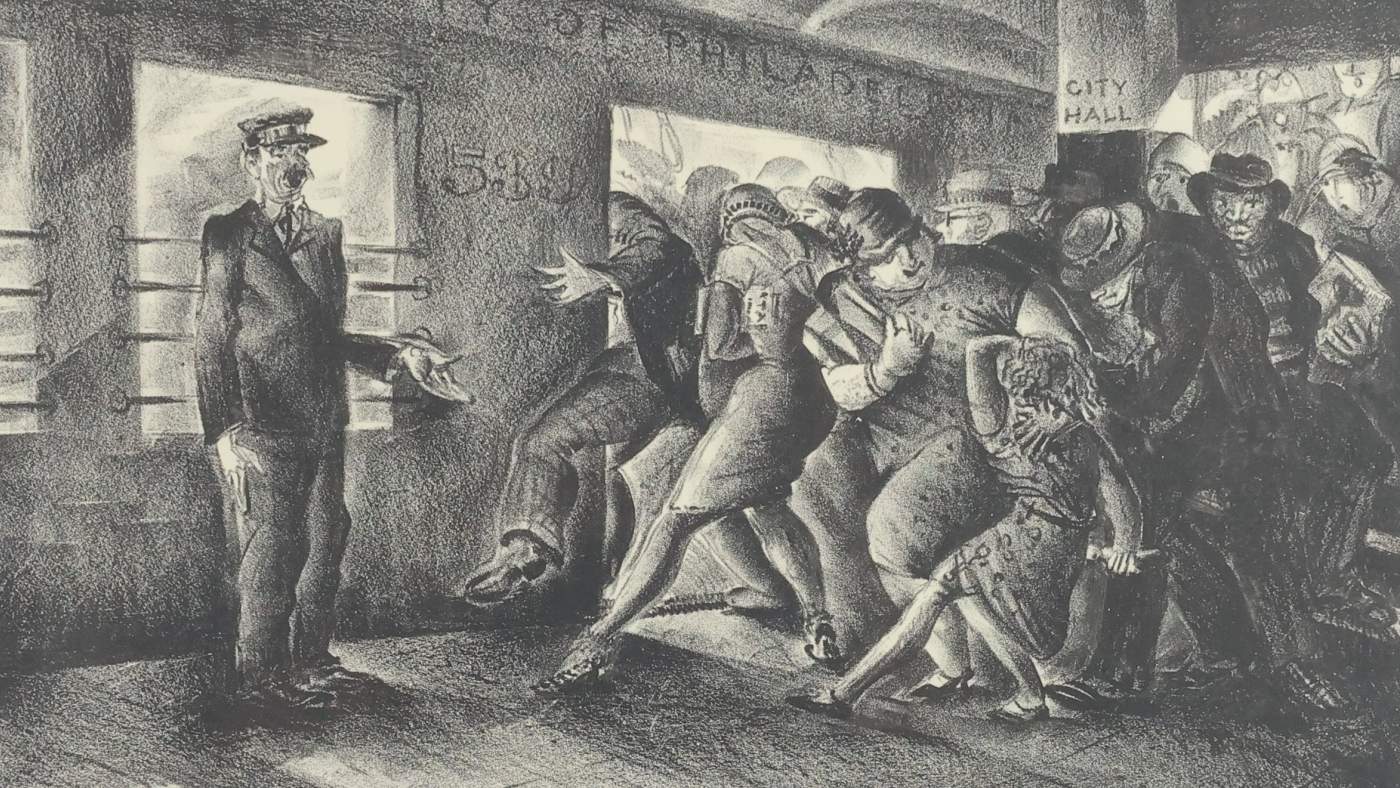
Spruance found similar visual possibilities in urban life. In this lithograph, a crowd presses toward public transportation while a uniformed figure stands apart from the movement. The contrast is striking. One figure appears comparatively still while the crowd becomes a compressed wave of human bodies. Spruance organizes the apparent confusion carefully. Repeated heads, shoulders, hats, and limbs create visual patterns. Architecture provides structure while the people supply motion. The scene captures an experience that remains familiar: the rush of people moving through a crowded transportation system.
Crowds and the Rhythm of American Life
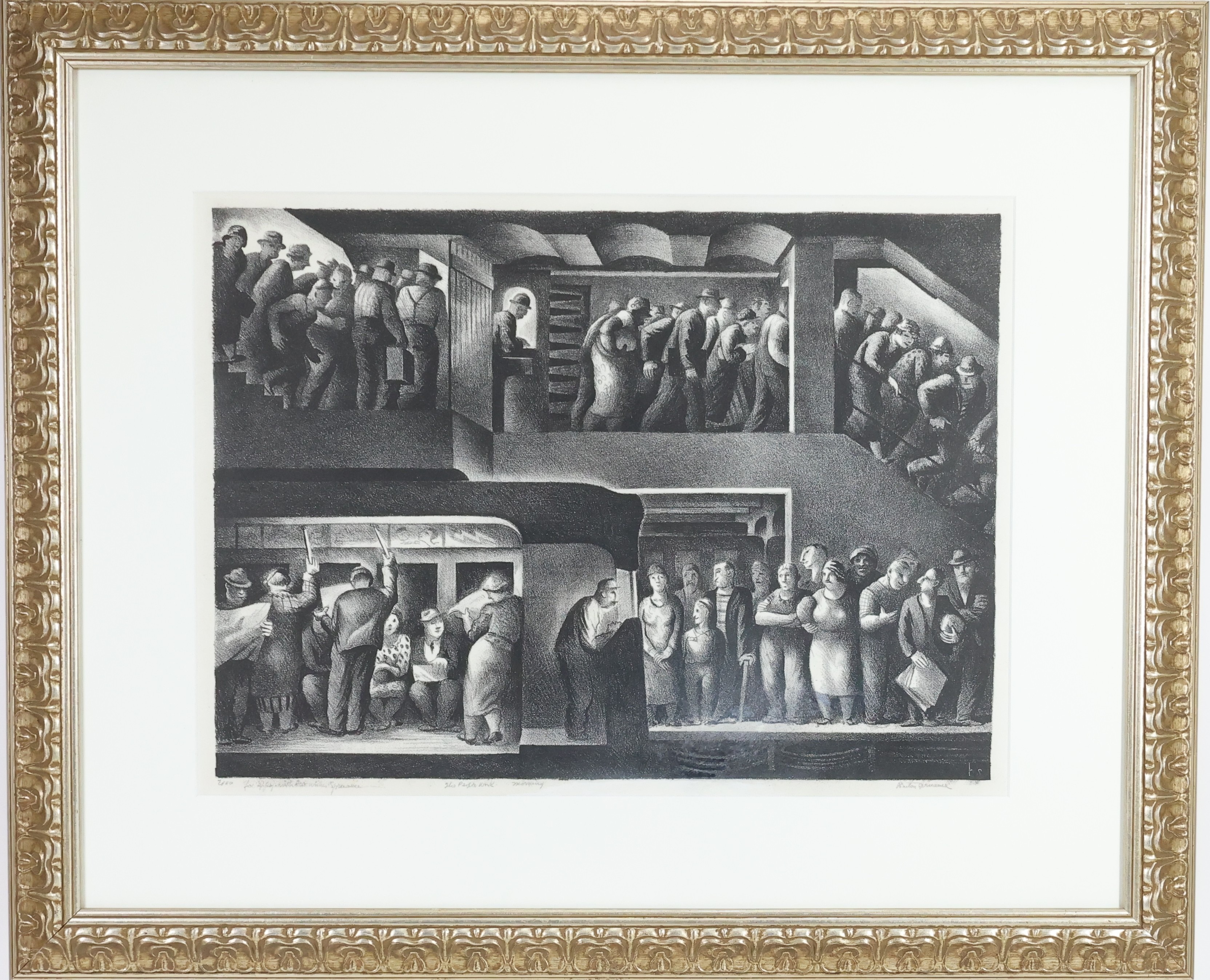
Another auction lithograph expands Spruance's interest in crowds into a more complex composition. Here, groups of figures occupy different areas of the image, creating the impression of several moments unfolding at once. People wait, board, move through confined spaces, and gather together. Rather than concentrating on a single individual, Spruance turns the crowd itself into his subject. This interest connects his work to the broader American Scene movement while also pointing toward abstraction. Figures remain recognizable, yet they increasingly function as shapes within a larger design. The same artistic mind that transformed football players into sweeping patterns could transform commuters into rhythms of dark and light.
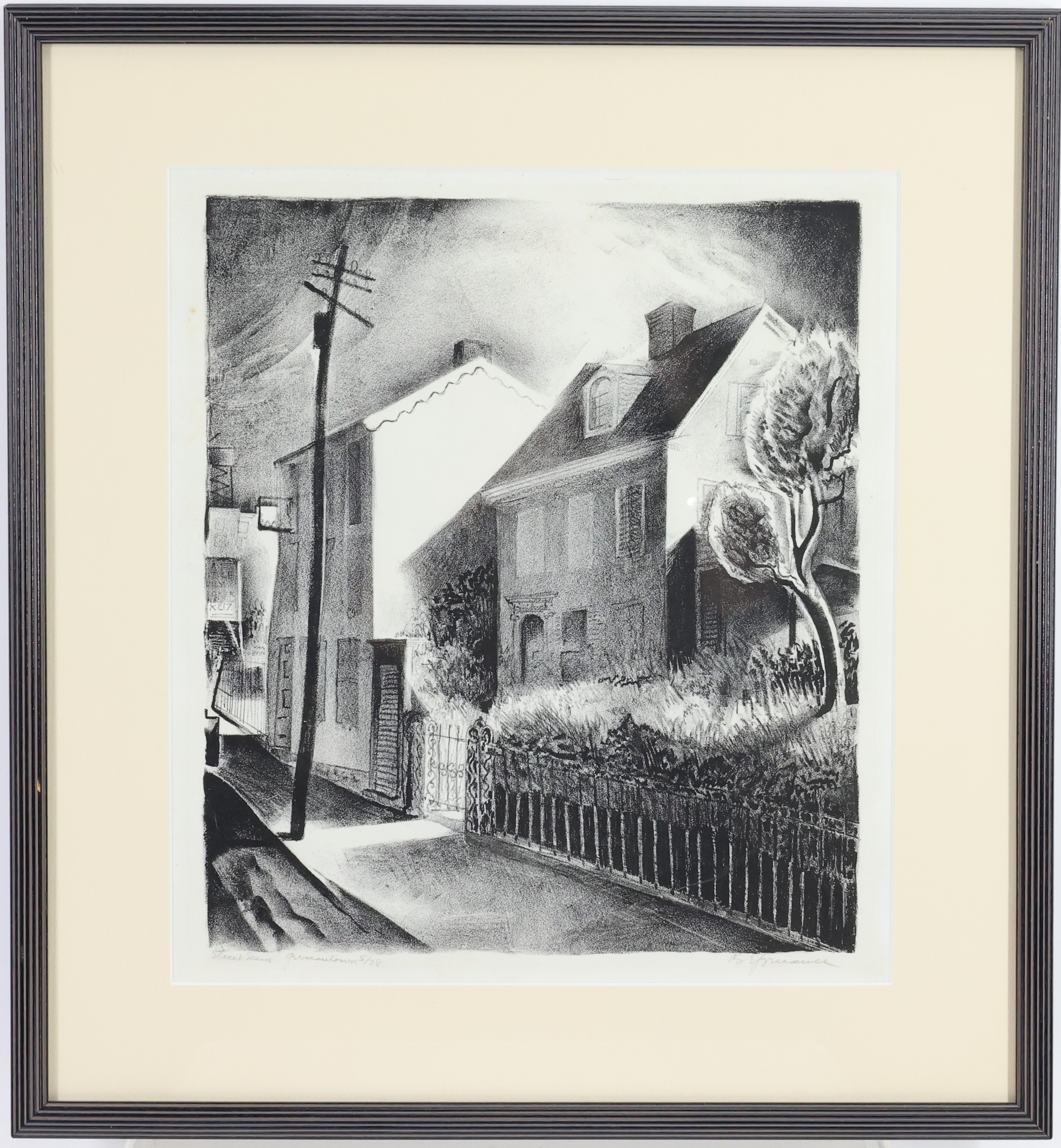
Benton Spruance, Street Scene, Germantown, lithograph. Offered in Alderfer’s September 10 Fine Art Auction.
A Quieter View of Pennsylvania
The fifth lithograph offers an important contrast. Here, groups of figures occupy different areas of the image, creating the impression of several moments unfolding at once. People wait, board, move through confined spaces, and gather together. Rather than concentrating on a single individual, Spruance turns the crowd itself into his subject.This interest connects his work to the broader American Scene movement while also pointing toward abstraction. Figures remain recognizable, yet they increasingly function as shapes within a larger design. The same artistic mind that transformed football players into sweeping patterns could transform commuters into rhythms of dark and light.
Why Collectors Seek Benton Spruance Lithographs
Spruance's lithographs appeal to several areas of collecting at once. His work is relevant to collectors of American Scene art, twentieth-century printmaking, Pennsylvania artists, modernism, sporting art, and urban imagery. Collectors evaluating a lithograph should look beyond the subject alone. Edition, signature, impression quality, paper condition, provenance, rarity, and overall condition can all affect desirability. Individual impressions may differ, making careful examination important. Prospective bidders should consult each auction catalog entry for dimensions, edition information, signatures, condition reports, estimates, and provenance when available. Institutional collections are also useful when researching an artist. The Philadelphia Museum of Art provides an excellent starting point for exploring American art and printmaking associated with Philadelphia.
Five Spruance Lithographs at Alderfer’s September 10 Fine Art Auction
Seen as a group, these five works tell a broader story about Benton Spruance. The two football scenes are particularly effective together. Thrill of the Game presents the stadium and spectacle, while Shovel Pass brings the viewer directly into the collision and movement of the players.The transportation scenes shift that energy from athletics to everyday urban life. Instead of athletes competing on a field, ordinary people hurry through the modern city. Finally, the Germantown street scene slows everything down, showing that Spruance could find compelling structure and atmosphere even without a crowd. Together, the five lithographs reveal an artist continually searching for the rhythms beneath American life.
The Enduring Appeal of Benton Spruance
Benton Spruance had a remarkable ability to find structure within movement. A crowded station became an arrangement of bodies and architecture. A quiet Pennsylvania street became a study in light and geometry. And on the football field, players became powerful combinations of speed, force, shadow, and form. The five lithographs featured in Alderfer’s September 10 Fine Art Auction provide a compelling look at that range. In particular, Thrill of the Game and Shovel Pass show how one familiar American sport could inspire two dramatically different artistic visions. Nearly a century later, Spruance's subjects remain recognizable. Crowds still rush for transportation. Stadiums still come alive under artificial lights. Players still collide while spectators watch from the sidelines. Spruance captured those moments—but more importantly, he captured the rhythm beneath them.